
QuickBooks Payroll Servicefor a payday you still run.
Somebody gets paid Friday and the accounts are still dark. We open the federal and state wage accounts, connect a provider you keep the login for, set the owner's wage and the chart those paydays post to, and then the pay click stays yours. Steven Palmieri, Tax CFO, the Entrepreneur's CFO, makes that call with you and leaves the pay click in your hands. The morning ends when you can sign in.
- The federal number
- The state wage account
- A login you keep
Which account is still dark.
You keep the login.

You will be talking to the Steven Palmieri practice.

Before anyone is paid
A December wage file does not wait on anything. The accounts open first.
Click to see the first payday ›Tap to see the first payday ›
The state wage account
A crew paid on Saturday needs the state account open by Friday.
Click to see the state account ›Tap to see the state account ›A draw is not a wage
A draw is not a wage.
Click to see the owner wage ›Tap to see the owner wage ›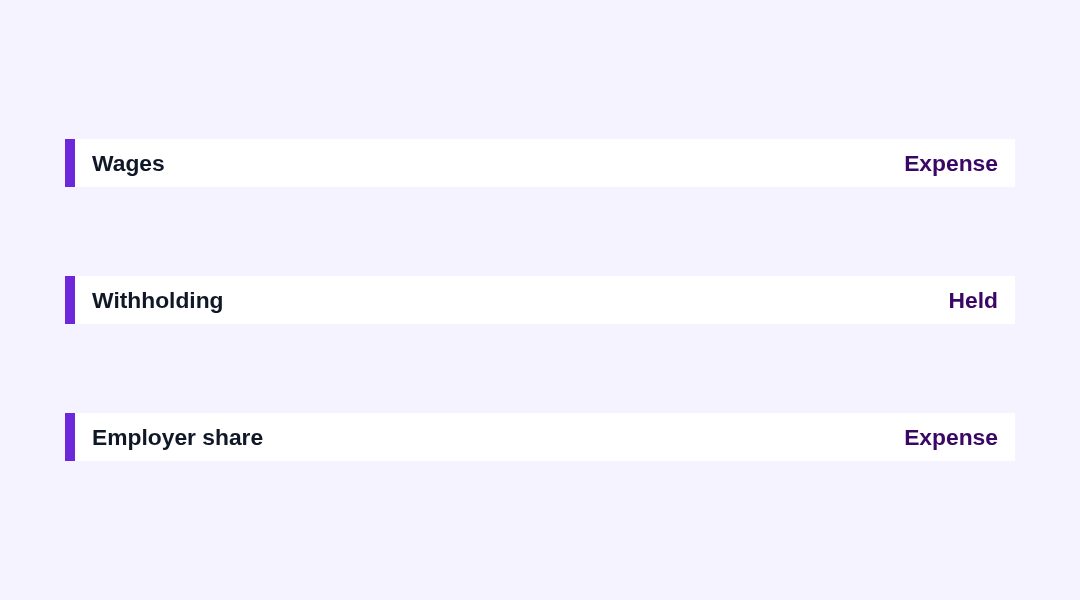
More than one account
Wages, withholding and the employer's share are three lines, and they post to three places.
Click to see the chart ›Tap to see the chart ›
Who does the work
The draft is read against the bank.
Click to meet the practice ›Tap to meet the practice ›
Name the first payday
Name the first Friday the papers can support.
Click to pick a time ›Tap to pick a time ›Six gaps before a payday you run.
Open one gap. That is the morning we start.
1No federal employer number yet
We stay on the call while you apply, after the company papers exist.
The number is free, and the name on it has to match the formation papers. A second try the same day is the mistake the IRS page warns about.
2The state wage account is still a rumor
We open the state wage account before anyone is added to a roster.
A quarterly wage report and a new-hire report are two different filings. One does not stand in for the other.
3The provider is picked and nobody can sign in
We connect the login you will keep, and we stop before the pay click.
Setup ends when you can see the roster, the draft date, and who sends the quarterly forms. The payday after that is yours.
4A first hire has no W-4 in the folder
We put the form, the start date, and the state's new-hire report on one list.
The new-hire report is a state filing with its own deadline, and a W-4 is what tells you the report applies. January is a late month to discover a rule the state already published.
5Owner pay is a draw with no wage behind it
We separate the wage for the work from the money you take out after that.
On an S corporation the wage comes before a non-wage distribution. The amount is a conversation with this year's facts, not a percent we recite.
6The chart has one account called payroll
We split wages, employer taxes, and amounts held back until they are sent.
One bucket hides the money that was never yours. The bank can still match, and the return can still be wrong.
Tax CFO
The person on the call.
You bring the login.
What we will not click
We do not run payday, and we do not sign an attest report.
Click to read the limit ›Tap to read the limit ›What the short lines still mean
The morning ends when you can sign in. The pay click stays yours. Owner pay on an S corporation needs a wage for the work, written down before the first draft. A draw with nothing under it leaves the return guessing. Steven Palmieri, a Tax CFO and the Entrepreneur's CFO, sets the wage and reads the draft against the bank. The return follows those months. A busy week still needs the wage account before the extra hours are paid. Name the first Friday the papers can actually support.
On the call, Steven Palmieri looks at the next draft date and asks whether the wage account can fund it. You bring the login. We bring the order of the morning. You keep the login, and you are the person who releases the draft. We open the federal number and the state wage account on a video call, then the payday stays in your hands. We do not run payday, and we do not sign an attest report. The fence is written out on its own page.
What the morning actually includes
People say payroll and mean six different jobs. On this door the morning is specific. The company already exists on paper. You apply for the federal employer number in the name on those papers, and the number comes back free. The state where you employ people gets its own wage account. You pick a provider, and the roster, the pay schedule, and the deposit path are turned on while you can still see them. A W-4 sits in the folder for each employee. A contractor has a W-9 from the week the work started, not from the week a form is late.
The chart is part of the same morning. Wages are an expense. Taxes the company owes on top of wages are an expense. Amounts held back from paychecks are not income and not a spare cash pile. They sit as amounts you are holding until the provider sends them on. Owner pay, when the company is an S corporation and you work in it, is a wage on that same roster before any non-wage distribution.
We learned this shape from the IRS pages on employer numbers, deposits, and S corporation pay, and from the new-hire page your state publishes. The pages are named where a figure appears. Nothing here is a client's roster. A federal confirmation and a state account number are two papers. Owners who frame one of them and forget the other meet the gap on the first Friday, when a person is already waiting to be paid.
What a finished month looks like after that
Once the morning is over, you run payday. We do not take the click back because a week got loud. What we do look at is the summary the provider already produced, set beside the cash that left the bank. Wages, employer taxes, and the amounts that were held back should tell one story. If the bank draft is larger than the summary, something else left the account and it needs a name. If the summary is larger than the draft, the provider is waiting on money you have not put there yet.
A month can match the bank and still be unfit for a return. The usual reason is a draw posted as wages, or wages posted as a draw. The cash is real either way. The label is what the return will believe. We would rather fix the label in the month it happened than discover it in March, when the W-2s are already in the mail and everyone is tired.
Relief, when it comes, is ordinary. You know the date the draft will hit. You know the account it hits. You know the folder where the summary lives. The worry of a letter from the state gets smaller when the account the letter is about already exists.
The dates the morning creates
Federal employment tax has a calendar, and we do not invent a second one. Employers generally file Form 941 for the quarter. Federal unemployment tax is reported on Form 940, and a deposit of that tax is required for a quarter in which the amount due is more than five hundred dollars, due by the end of the following month. Only the employer pays that unemployment tax. It is not held back from the paycheck. Deposits of the withheld taxes are electronic. The IRS page names free paths and paths that can charge a fee, including a bank or a payroll company you already trust.
Which weeks you deposit, monthly or semiweekly, is a question Publication 15 answers before the calendar year starts. We do not type the lookback dollar line onto this site. The publication is the page to have open on the day you check, because that line can move and a frozen number would be a favor to nobody.
The state adds its own rhythm beside the federal calendar, and the rhythm is the one printed on your state's page, not a number we freeze here. A new hire or a rehire is reported on the deadline that state publishes, when a W-4 is required. The quarterly wage report is a different filing and does not take the place of that new-hire report. Unemployment tax uses the wage base and the rate on the notice the state sent you. A new employer's entry rate and an experience-rated employer's range live on that notice and on the state's table for the year. We read the notice with you. A rate typed onto this page would go stale by spring, so the number stays on the notice. Those figures are the state's, read on the day you check, not a quote we made up for a pitch.
The feeling on that morning is the same in every state. You want the person paid, and you want the letter that asks about a missing account to have nowhere to land. The federal deposit weeks and Form 941 still arrive on the IRS calendar. The state report arrives on the state's calendar. Writing both dates on one page is how the two errands stop pretending to be one.
How the return uses the morning
A return drafted from unfinished paydays is a return that will be redone. We wait until the provider summaries and the bank agree, and until owner pay is labelled the way the company actually works. Depreciation, sales, and the rest of the year have their own pages on other doors. On this door the point is narrower. The wage line on the return should be a wage you can point at, on a roster, with a W-2 behind it.
Health coverage the company pays for a shareholder who owns more than two percent of an S corporation is reported as wages in box 1 of the W-2 when the plan rules on the IRS compensation page are met. The same page says those premiums are not Social Security and Medicare wages in boxes 3 and 5 under the rule it describes. We open that page again before a return season, because the notes on it change. We do not freeze a market-reform paragraph onto a marketing site.
If a notice arrives, you will hear what it is asking before you have to guess. A late deposit, a missing quarterly form, and a worker the state thinks is an employee are three different letters. Setup can cause all three. So can a provider setting nobody confirmed. Telling them apart is the useful part. Becoming the filer of record is not.
Name the first payday.
Tell us the first date you need someone paid. We will say whether the accounts can be ready, or whether the honest answer is that they already are.
You will be talking to the Steven Palmieri practice.